Metroidvania Research
Seven game ideas, what makes them worth exploring, and the research behind them.
1. The lead idea: a deep-sea heat metroidvania
Why it's fun
It plays like a platformer with gravity flipped: You fall upward, and going deeper means using the terrain. Everything you do is movement, and movement is also how you fight.
Moving
- You naturally float upward, because a warm diver rises in cold water.
- Walk on the ground, and grip ceilings to crawl along them at walking speed.
- Jump up off the ground, or push down off a ceiling, for free.
- Surge to shoot straight up fast.
- Dash left or right. Hold the other direction mid-dash to cut it short.
- Stroke: a small push toward your mouse, in any direction. You get a few strokes (probably 3, like a triple jump), and they refresh when you touch a floor, ceiling, launcher or refuel point.
- Launch: move into a launcher to float safely inside it, then stroke toward your mouse for a big push.
- Down-currents carry you deeper, and up-currents push you up and block the way down.
Fighting
- Anything you hit fast enough takes damage, and faster hits do more. Push-offs and launches hit the hardest.
- Slow bumps are a bad idea: Below a certain speed, the creature hurts you instead.
- Enemies attack each other too, so you can knock or lead them into each other and let them fight.
- Hang from a ceiling above a fight and drop in when the time is right.
- The dash never runs out. Its cooldown resets when you hit something or touch a surface, so you can always fight.

Floors and ceilings are always grippable unless lined with hazards like spikes. Side walls can't be gripped, since you can only hold onto what pushes back: Boots clamp you to floors and your float presses you into ceilings, but nothing presses you into a wall, so you slide up it. Running out of strokes mid-water is never a trap either, because you just float back up.
| Move | What it does | Limit |
|---|---|---|
| Float | Rise slowly while steering. | Always on unless you're holding on |
| Surge | Shoot straight up, faster the longer you hold it. | None |
| Jump / push-off | Jump up off the ground or push down off a ceiling, with a strong first boost. | Needs a floor or ceiling |
| Stroke | A small push toward the mouse. | A few charges (3 to start), refreshed by touching a floor, ceiling, launcher or refuel point |
| Dash | A fast move left or right; hold the other direction to cut it short. | Cooldown, reset early by a hit or touching a surface |
| Launch | Float safely inside a launcher, then push out toward the mouse. | Needs a launcher |
Proposed controls (keyboard and mouse)
| A/D | Walk, steer, or crawl along a ceiling |
| Space | Jump off the ground, or push off a ceiling |
| Hold W | Surge |
| Left click | Stroke toward the mouse (inside a launcher, launch instead) |
| Shift + A/D | Dash (hold the other direction to cut it short) |
Rising into a safe ceiling grabs it automatically.

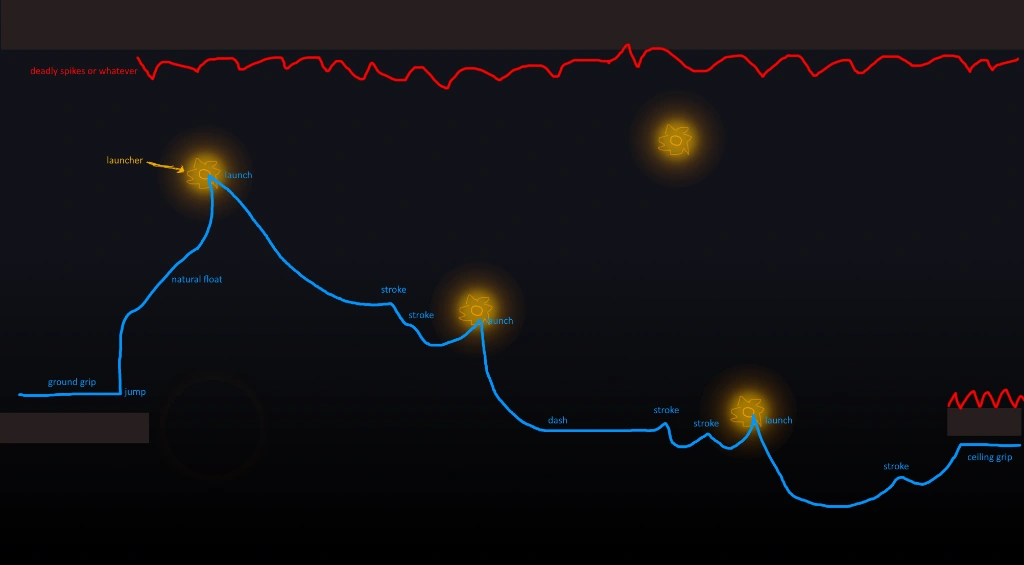
Possible addition: some enemies could fear heat and back away from a bright headlamp (still just an idea).
Heat, health and recovery
Heat powers your abilities and your headlamp, and movement never uses it.
Heat and health each run from 0 to 100. You get heat from refuel points and diving bells, and you spend it on the flare, the heat shield and the charged dash. More heat also lets your headlamp see farther, which matters more and more because deeper water is darker. At zero heat you can't use those abilities and can barely see, but you still move and fight normally.
Diving bells hang from above, so you float up into them. They refill your health and heat, save your progress and reveal the nearby map. Health damage never shortens how far you can move.
Possible addition: a relic that gives you a little heat whenever you land a bash.
What opens the map
Pressure valves are world objects: After a regional objective or boss, you turn one to equalize a pressure lock and permanently open a route.
These reusable abilities open both the main path and secrets in earlier areas:
- Current steering: reward from the Level 1 boss. Steer inside down-currents instead of just being carried along, which reaches Level 2 and earlier alcoves.
- Charged dash: found in Level 2, costs heat. Cuts across currents, punches down through up-currents, and breaks fragile coral.
- Flare: reward from the Level 2 boss, costs heat. Briefly reveals routes, items and clues, including the path to the next valve. Required clues always have a refuel point nearby.
- Heat shield: reward from the Level 3 boss, costs heat. Brief protection from environmental heat (followed by a recovery period) opens Level 4 and overheated side paths, though enemy bites still hurt.
Dashes stay horizontal, strokes are small and limited, and launchers and down-currents handle the longer descents. That limits how deep the starting moves can reach (although how far three strokes can go still needs testing). Up-currents and pressure locks stop you from going deeper too early, and rising never needs an ability. Ideally, secrets open through what an ability lets you do, not a door that just checks whether you own it.
The optional harpoon tether is outside the initial scope; if added, a fast swing could bash creatures too.
The world and story
From the pier, you descend through four levels.
Refuel points get scarcer until Level 4, where avoiding heat becomes the main problem. Levels 1 to 3 each have a boss, and Level 4 has the final boss.
Murals reveal a cycle: A diver kills the creature that keeps the sea warm, founds a kingdom, and watches it freeze and sink. Warm things rise and cold things sink, which is why the kingdoms sank once they lost their heat (and why the warm diver keeps floating up). At the final boss, you can repeat the cycle and be crowned, or keep the sea warm. Hidden rooms tell the rest through earlier drowned kingdoms.
Scope and what to test
A first prototype needs to check:
- whether floating feels like freedom rather than a fight with the controls,
- whether three strokes feel right,
- whether players can tell a fast hit from a slow bump,
- whether enemies reliably fight each other,
- and whether ceiling crawling feels natural at speed.
Current scope: PC, keyboard and mouse or controller; 3–4 hours, about 70 rooms, eight enemy types and four bosses, with inked characters on painted backgrounds. Story mode halves environmental burns, keeps heat above a quarter and widens launch timing. All of this still needs testing.
2. What the market looks like
To see what's realistic for us, we looked at every Steam metroidvania and 2D souls-like released from 2021 to mid-October 2026: games, flops included. To be fair to newer games, the numbers below only count the that had been out for at least a year.
Price is the biggest signal by far. of games priced $10–19.99 reached 500 reviews, against of games under $5 and at $5–9.99. That's most likely because price tracks how big and polished a game is, not because charging more sells copies. In fact, price and time on sale alone pick out the hits almost as well as when a game's tags are added too, so how well a game is made and sold matters a lot more than what it's about.
It's also getting harder: of 2021 releases reached 500 reviews, against of 2025 releases (partly because newer games have had less time).
3. Steam tag rankings and crowding: what helps and what hurts
Rather than forecasting arbitrary hit odds for unreleased games by guessing store tags, the reliable empirical signal from the 1,245-game census is looking directly at how individual Steam tags perform and whether they are crowding in. In our validated model, advertised design features (story themes, mechanics, setting) added zero additional predictive weight once Steam tags and price/age controls were included (weights: 0% design, 60% tags, 40% controls). Because model predictions for hypothetical pitches are driven entirely by guessed tags, any score can be artificially inflated or depressed simply by picking different tags that "kinda fit."
Furthermore, niche themes like Underwater (only 5 games across all of Steam in 2021–2026 meeting criteria, with 1 hit: Pronty) are too rare to model reliably—they require at least 25 games to receive a coefficient. Below, all 56 tags with enough data to measure are plotted and ranked across two dimensions: how fast they are crowding in (growth in share of new releases from 2021–23 to 2024–26) against how much they change the odds of reaching 500 reviews compared to a similar game without the tag.
Baseline: In the $10–19.99 band at 24 months, a typical game reaches 500 reviews about 17% of the time (12.3% across the entire population). Odds multipliers reflect held-out logistic regression coefficients with 90% bootstrap ranges from 200 resampled refits. Release growth measures the change in new release share (2024–26 vs. 2021–23). Tags held by fewer than 25 games (like Underwater, n=5) are excluded from the model.
What this means for game developers
- Enthusiast niches carry the strongest positive premiums: Female Protagonist (2.74x), Anime (2.19x), Horror (1.57x), Dark Fantasy (1.41x), and Souls-like (1.37x) consistently lift the probability of finding an audience. Players actively search out these specific experiences.
- Generic and casual tags create massive drag: Casual (0.34x), Hack and Slash (0.55x), Nonlinear (0.58x), and 2D Platformer (0.73x) are heavily penalized. This is not because 2D platforming is inherently flawed, but because it is a saturated dumping ground (487 games in training) where low-effort titles pool, driving down median visibility.
- The takeaway for the Deep-Sea Pitch: Movement-first platformers naturally attract tags like 2D Platformer and Adventure, which suffer from crowding drag. Meanwhile, Underwater represents completely open creative white-space: with only 5 games in the census, there is no evidence that players dislike underwater settings. If the game leans into atmospheric tension, challenging boss encounters, or tight kinetic traversal, positioning it around Atmospheric, Precision Platformer, or Dark Fantasy communicates its appeal much better than broad casual tags.
4. Exploring the subgenre: six other creative concepts
Each concept explores a different gap identified in the 250-game design atlas, pairing themes and mechanics that rarely appear together:
| Idea | What you do | Why it is interesting | Natural tag profile |
|---|---|---|---|
| Dark language-puzzle metroidvania | Learn a dead language and combine words to affect doors, creatures and water in a decaying world. | Understanding replaces keys. Familiar places change meaning as your vocabulary grows. | Puzzle, Exploration, Dark Fantasy, Story Rich |
| Dark Japanese folklore game | Learn each yokai's rule, then bargain, trick or fight it. Peaceful solutions grant traversal powers. | Monster knowledge changes combat and exploration. Clear clues and careful folklore research are essential. | Souls-like, Dark Fantasy, Folklore, Action |
| 3D bird-flight platformer | Keep flying through a cliff city using dives, updrafts and wall-skims. Never land. | One clear rule makes the world a movement challenge. Test the camera and 3D production cost early. | 3D Platformer, Flight, Exploration, Atmospheric |
| Gothic moth platformer | Fly through a cathedral, skimming flames for speed while avoiding burns. | Fuel and danger share one source. Movement gives the gothic setting a different focus. | Gothic, Dark Fantasy, Platformer, Hand-drawn |
| Starship-cathedral action game | Duel with holy relics that are misunderstood technology. Manuals reveal their real uses. | The world reveal unlocks abilities, connecting the story to play. | Sci-fi, Souls-like, Hack and Slash, Story Rich |
| Two-player ecosystem game | A fungus and an alga grow life across barren rock. Arriving creatures become tools and routes. | Cooperation changes the map itself. The challenge is keeping the living system easy to read. | Puzzle Platformer, Cute, Online Co-Op, Casual |
Original pitch, shown for comparison: descend the ocean dungeon with a cutlass, harpoon and trident to defeat the molten dragon and found a kingdom (carries Hack and Slash, which carries a 0.55x penalty due to heavy action crowding).
Where the games sit in the design space
5. How we did it, and the limits
Data. We took Steam's Metroidvania and Souls-like store lists on 16 October 2026, kept games released from 2021 onward, and included 2D souls-likes. The success outcome is at least 500 all-language reviews by that snapshot. The model uses all games out for at least a year: hits and non-hits. Store descriptions and top-20 tags for this model were collected on 18 October; the outcomes stay frozen.
Design evidence. Every game and idea gets the same rules and input budget: up to 300 description characters and seven tags. We collected up to 20 tags per real game but score only its top seven, matching the seven main concept tags. We retain directly advertised verbs, mechanics, structure, setting, cultural references, art and avatars. The original 148-column vocabulary is preserved; columns have varying observations and have at least 25 examples in the census. Each training fold applies that support requirement separately. Inferred themes, emotional experience and execution quality remain unscored. Each positive observation has a source phrase.
Model and checks. Three regularized logistic views use design evidence, raw tags, or price/time/budget/IP controls alone. Tuning, scaling, frequency filtering, calibration and the combination weights are learned within training folds. The final weights are design, tags and baseline. Retrospective out-of-fold AUC is (0.5 is chance, 1 is perfect), versus when whole mixed batches are held out. The ranges come from 200 refits with retuned models and combination weights.
Limits. This was an exploratory repair of the earlier scoring method using the same historical outcomes, not a new prospective release test. Names and outcomes do not enter the evidence encoder, but post-launch store copy and tags can still reflect success. Our ideas' copy and tags are hypothetical. The ranges approximate model-fit uncertainty; they omit execution, marketing, annotation truth and future market changes. Price tracks scope and budget rather than causing sales. Games without a Metroidvania or 2D Souls-like tag are outside this population. The map and tag-effect charts retain the original population tag analysis.
The original research atlas describes the top 250 games on 148 hand-scored traits. For this paper's updated comparison, see the validation report, model results, held-out game predictions and recorded feature evidence. The full list of games is in population_games.csv.
6. The games
All games in the study. Search by name or tag, or click a column heading to sort.
* Out for less than a year on 16 October 2026, so not used in the model.